
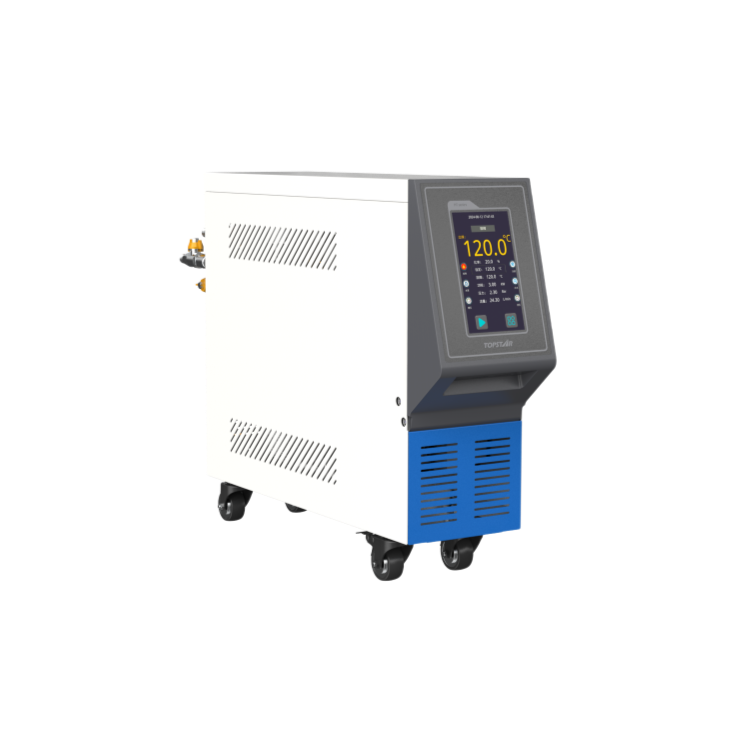
Mould temperature plays a crucial role in determining the overall efficiency of the injection moulding process. It affects not only the quality of the final product but also the injection molding machine‘s cycle time, energy consumption, and mould life. In competitive manufacturing environments, optimizing the cooling phase of the moulding process can significantly improve production efficiency. mould temperature controllers (MTCs) play an indispensable role in this. By maintaining the mould temperature within its optimal range, these devices can help reduce cooling time by 25% or more.
How mould Temperature Controller Optimize Cooling Dynamics
To understand how mould temperature controllers can reduce cooling time by more than 25%, it’s essential to understand the basic principles of mould cooling: molten plastic is injected into the mould, and heat must be removed from the plastic to allow it to solidify. The heat transfer rate depends on two key factors: the temperature difference between the mould and the cooling medium (water or oil), and the mould’s thermal conductivity. Standard temperature control systems operate at fixed flow rates and temperatures, resulting in uneven heat distribution—hot spots in the mould trap heat, prolonging cooling time. High-performance mould temperature controllers address this problem by dynamically adjusting temperature and flow rates to optimize heat transfer.
The working principle is as follows: Topstar’s mould temperature controller uses a precision PID control system to maintain the cooling medium at a stable, optimal temperature. It is also equipped with a variable-speed pump that adjusts the flow rate based on real-time mould temperature data—increasing flow in hot spots to accelerate heat dissipation and reducing flow in areas with good cooling performance.
Core Functions of a Mould Temperature Controller for Shortening Cooling Time
The key to shortening cooling time with a mould temperature controller lies in precise temperature control. Even slight fluctuations in the cooling medium temperature (±2℃) can extend cooling time by 10-15% and lead to inconsistent part dimensions. High-quality mould temperature controllers can maintain temperature accuracy within ±0.5℃, ensuring optimal heat transfer throughout the entire cooling cycle. Topstar’s mould temperature controller goes a step further, employing dual-zone temperature control technology to separately regulate the cooling medium for the mould cavity and mould core. This is crucial for complex parts because the mould core typically accumulates heat more easily than the mould cavity. For example, when moulding plastic gears, the mould core requires more robust cooling than the mould cavity.
Standard single-zone systems overcool the mould cavity to accelerate core cooling, potentially leading to shrinkage. Dual-zone mould temperature controllers, however, independently regulate each zone’s temperature, reducing cooling time while maintaining part integrity.
How to Maximize Heat Dissipation Efficiency?
The heat exchanger in a mould temperature controller is the core component that dissipates heat from the cooling medium before it circulates back to the mould, and its design significantly impacts cooling efficiency. Traditional mould temperature controllers use shell-and-tube heat exchangers, which have limited heat transfer surface area, resulting in slow heat dissipation. High-performance models like Topstar’s mould temperature controllers use plate heat exchangers, with a surface area three times that of shell-and-tube exchangers. This larger surface area accelerates heat transfer between the cooling medium and refrigerant, causing the medium temperature to drop faster and absorbing more heat from the mould in each cycle.
Furthermore, Topstar’s heat exchanger uses a counter-flow design—the cooling medium and refrigerant flow in opposite directions—maximizing the temperature difference and further improving heat dissipation efficiency. The result is that the cooling medium returns to the mould at a lower, more stable temperature, reducing mould cooling time by 20% to 25%.
Topstar mould temperature controllers are adjustable to meet the needs of moulds and parts.
Flow rate is another key factor affecting cooling efficiency—too low a flow rate results in slow heat dissipation; too high a flow rate leads to energy waste. Advanced mould temperature controllers employ intelligent flow control technology to adjust the flow rate according to the specific needs of the mould, thereby further reducing cooling time. Topstar’s mould temperature controllers are equipped with variable-frequency drive (VFD) pumps that adjust flow rate in real time based on feedback from temperature sensors within the mould. For example, when molten plastic is first injected into the mould, the pump increases the flow rate to its maximum to quickly remove excess heat.
As the plastic solidifies and the mould cools, the pump reduces the flow rate to maintain optimal temperature, avoiding overcooling and energy waste. This adaptive flow control is particularly effective for parts with varying wall thicknesses: thicker sections require higher flow rates to accelerate cooling. In comparison, thinner sections require lower flow rates to prevent stress buildup.
Working with mould Cooling Channels
The effectiveness of a mould temperature controller depends on its compatibility with mould cooling channels—a well-designed controller can even enhance the performance of already-optimized channels. Modern moulds employ complex cooling channel designs that conform to the part’s shape to maximize heat transfer efficiency. High-performance mould temperature controllers are designed to work seamlessly with these advanced cooling channels, ensuring uniform flow and temperature distribution. For example, Topstar’s mould temperature controller features a wide flow range to meet the narrow and complex channel requirements of conformal cooling moulds. It also features pressure sensors to monitor channel flow resistance and alert operators to blockages or obstructions, preventing slowdowns in cooling.
The Key to Faster Cooling and Higher Productivity
High-performance mould temperature controllers transform cooling from a time-consuming process into a competitive advantage by optimizing heat transfer, precise temperature control, and fluid dynamics.” A reduction of over 25% in cooling time is no exaggeration; it is the culmination of proven technologies: precise PID control, efficient plate heat exchangers, intelligent flow regulation, and seamless compatibility with advanced cooling systems. Topstar’s mould temperature controllers integrate these technologies to deliver consistent, measurable performance superiority to manufacturers in industries such as packaging, automotive, medical, and consumer goods.