
Despite the rapid development of cloud platforms and virtualized environments, dedicated servers remain an important part of modern IT infrastructure. For many use cases, they still provide the best balance between control, performance, and cost predictability.
Unlike VPS and cloud models, a dedicated server provides a physical server entirely allocated to a single customer. This means no resource sharing, stable performance characteristics, and the ability to fine-tune the hardware configuration for specific workloads. For business-critical systems, these factors often outweigh flexibility and rapid scalability.
What is a dedicated server
A dedicated server is a physical server fully assigned to one customer and not shared with other users. All computing power, memory, storage, and network resources are used exclusively for the needs of a single project or organization.
At its core, a dedicated server is based on a single-tenant infrastructure model. This means that server performance does not depend on the activity of other customers, and all hardware resources are available in full, without limitations imposed by a hypervisor or virtualization platform.
When using a dedicated server, responsibilities are divided as follows:
- the provider is responsible for the physical facility, power, cooling, and hardware availability;
- the customer manages the operating system, software, data, and workload architecture.
This model is suitable for companies that require full control over their infrastructure, consistent performance, and the ability to tailor the server to specific requirements — from high-frequency CPUs to NVMe storage and specialized network configurations.
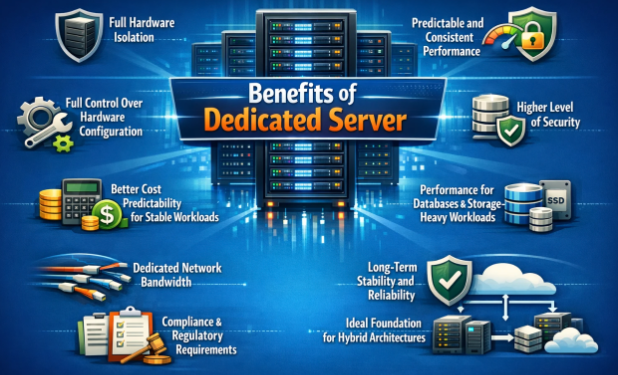
Benefit 1. Full hardware isolation
One of the key benefits of a dedicated server is complete hardware isolation. The entire server platform is used by a single customer, with no resource sharing with other users. This fundamentally distinguishes dedicated servers from VPS solutions and many cloud scenarios.
Hardware isolation means:
- no competition for CPU, RAM, disk I/O, or network resources;
- complete independence from the behavior of other customers.
This approach is especially important for production systems, where even short-term performance drops can lead to service disruptions, degraded user experience, or financial losses. A dedicated server eliminates the noisy neighbor effect and provides a stable environment with well-defined and predictable performance characteristics.
Benefit 2. Predictable and consistent performance
A dedicated server delivers predictable and consistent performance throughout its entire lifecycle. All resources — CPU time, memory, storage, and network capacity — are allocated to a single customer and are not dynamically shared or reallocated.
This provides several practical advantages:
- stable operation under peak loads;
- predictable latency and throughput metrics.
This model is especially important for databases, APIs, high-traffic web applications, and internal enterprise systems. Unlike cloud environments, where performance can fluctuate depending on overall platform load, a dedicated server offers a fixed level of resources and simplifies capacity planning.
Benefit 3. Higher level of security
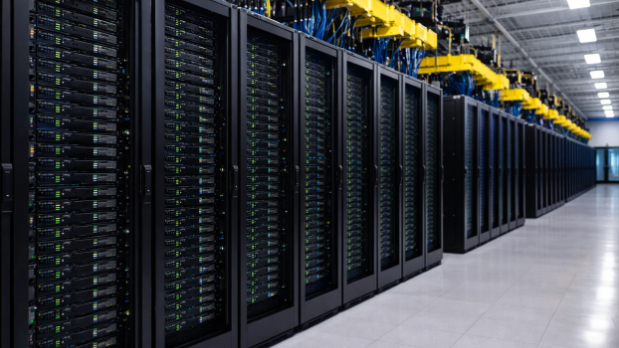
A dedicated server provides a higher level of security through isolation and full control over the environment. The absence of other tenants at the physical level reduces the attack surface and makes it easier to implement custom security policies.
Key security aspects include:
- physical isolation of data;
- full control over network and system architecture.
This is particularly important for companies working with sensitive data, financial systems, or internal corporate services. A dedicated server allows security models to be built without the constraints that are often present in shared or cloud infrastructures.
Benefit 4. Full control over hardware configuration
A dedicated server offers complete control over hardware configuration. Unlike cloud and VPS models, which provide a limited set of predefined templates, a dedicated server can be selected and configured to meet the exact requirements of a project.
The customer can independently define:
- CPU type and model, RAM capacity, storage configuration, and networking;
- the use of NVMe, RAID, high-memory, or high-frequency configurations.
This level of flexibility is especially valuable for non-standard workloads, where performance depends on specific hardware characteristics rather than abstract virtual resources. A dedicated server allows the infrastructure to be optimized for the task itself, rather than constrained by platform limitations.
Benefit 5. Better cost predictability for stable workloads
A dedicated server provides a predictable cost model, which is critical for projects with stable or predictably growing workloads. The server cost is fixed and does not depend on the number of operations, traffic volume, or the amount of time resources are used.
The main advantages of this model include:
- no unexpected bills or sudden cost spikes;
- straightforward financial planning for months or even years ahead.
For long-lived production systems, a dedicated server is often more cost-effective than cloud platforms, where expenses can grow rapidly as workloads increase or storage and network usage expands.
Benefit 6. Performance for databases and storage-heavy workloads
A dedicated server is well suited for workloads that are sensitive to storage performance and latency. Full control over the storage subsystem allows performance to be optimized for specific use cases.
Typical examples include:
- databases with high I/O intensity;
- storage, backup, and data-intensive services.
The absence of storage-level virtualization, combined with the ability to use NVMe and finely tuned RAID configurations, provides a clear advantage in terms of latency and throughput compared to shared solutions.
Benefit 7. Dedicated network bandwidth
A dedicated server provides exclusive network bandwidth without sharing it with other customers. This ensures stable operation of network services and predictable latency and throughput metrics.
Key advantages of the networking model include:
- no competition for bandwidth;
- stable latency under sustained load.
This is particularly important for APIs, streaming services, gaming platforms, and systems with a high volume of network traffic between infrastructure components.
Benefit 8. Long-term stability and reliability
A dedicated server is designed for long-term, stable operation. The hardware environment does not change dynamically, which simplifies maintenance and reduces the risk of unexpected changes in system behavior.
This level of stability provides:
- predictable operating conditions for years ahead;
- minimal changes to the environment configuration.
This makes dedicated servers a practical choice for long-lived enterprise systems, internal services, and legacy projects where stability is more important than frequent changes.
Benefit 9. Compliance and regulatory requirements
A dedicated server simplifies meeting compliance and industry regulatory requirements. Full control over hardware and data placement makes it easier to design infrastructure that aligns with regulatory standards.
In practice, this means:
- control over the physical location of data;
- simplified audits and compliance checks.
For companies operating in regulated industries, a dedicated server is often the most transparent and clearly defined infrastructure model.
Benefit 10. Ideal foundation for hybrid architectures
A dedicated server serves as a reliable foundation for hybrid infrastructures, where part of the workload runs in the cloud while core systems operate on dedicated hardware. This approach combines control and stability with the flexibility of cloud models.
In hybrid architectures, dedicated servers are typically used for:
- core systems, databases, and storage;
- persistent and predictable workloads.
Cloud resources are then applied for temporary tasks, peak scaling, or auxiliary services. This balance makes it possible to optimize costs without sacrificing performance or control.
Dedicated server vs VPS vs cloud
The choice between a dedicated server, VPS, and cloud depends on workload characteristics, control requirements, and the economic model. These options address different needs and are not interchangeable.
VPS and cloud solutions work well for rapid deployments, testing environments, and dynamic workloads. They provide flexibility, but often limit control over the hardware layer and may deliver unpredictable performance.
A dedicated server, in contrast, provides:
- full control over resources;
- stable and predictable performance.
It is better suited for production systems, long-lived projects, and use cases where transparency of architecture and costs is important.
When a dedicated server makes sense
A dedicated server makes sense when infrastructure needs to be stable, fully controlled, and designed for long-term operation. This model is especially effective for constant or predictably growing workloads.
A dedicated server is justified when:
- guaranteed performance without shared resources is required;
- control over hardware and network architecture is important.
At the same time, a dedicated server may be excessive for short-term projects, experimental environments, and scenarios with highly variable workloads, where cloud platforms offer greater flexibility.
Dedicated servers remain a relevant infrastructure solution for companies that value control, stability, and predictable performance. They provide hardware isolation, configuration flexibility, and a transparent cost model, making them a reliable foundation for business-critical systems.